The Best Coffee Beans for a Cafetière (And How to Brew Them)
A cafétière rewards good beans more than almost any other brewing method. Here’s how to choose the right coffee and get the most out of every brew.
The cafetière — or French press — is one of the most forgiving and rewarding ways to brew coffee. No paper filters, no complicated technique, no expensive equipment. Just coffee, hot water, and time. But that simplicity means the quality of your beans matters more, not less. Here's how to choose the right coffee for a cafetière and brew it properly.
Why Bean Choice Matters More in a Cafetière
Most brewing methods filter out the oils and fine particles from ground coffee. A cafetière doesn't. The metal mesh plunger lets the natural oils pass through into your cup — which is what gives cafetière coffee its characteristic richness and body.
This means a great bean tastes exceptional in a cafetière. It also means a mediocre bean has nowhere to hide.
What to Look for in Cafetière Coffee Beans
Full body and low-to-medium acidity The cafetière's immersion brewing style suits coffees with natural weight and sweetness. High-acidity origins like Ethiopia or Kenya can work, but they can also taste sharp or thin without the structure that espresso pressure provides. Brazilian and Colombian origins tend to shine.
Medium to dark roast Lighter roasts can taste underdeveloped in a cafetière — the longer brew time can pull out grassy or sour notes if the roast hasn't developed the sugars fully. A medium or medium-dark roast gives you the sweetness and body the method rewards.
Whole beans, ground coarse Always buy whole beans and grind just before brewing. For a cafetière, you want a coarse grind — roughly the texture of coarse sea salt. Too fine and the grounds will pass through the mesh and make your coffee gritty and over-extracted.
Fresh roast date Coffee is at its best within 2–6 weeks of roasting. Check the roast date, not just the best-before date. Stale beans produce flat, lifeless coffee regardless of how well you brew them.
Our Top Pick: Single Origin Brazilian Santos
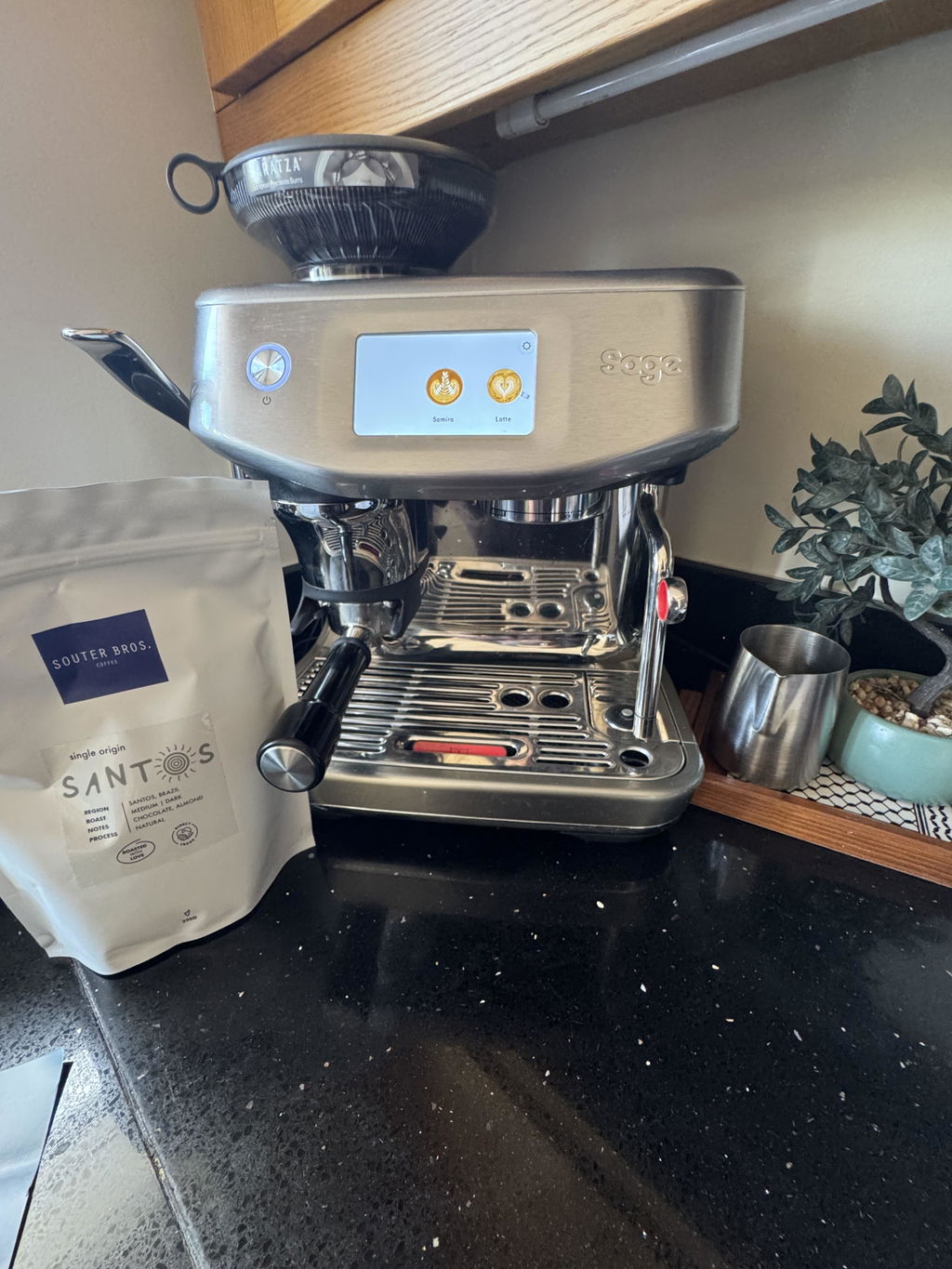
Our Brazilian Santos is one of the best coffees you can put in a cafetière. The natural processing gives it a full, round body with dark chocolate and roasted almond notes — exactly the flavour profile that immersion brewing brings out at its best. Low acidity means it's smooth and satisfying without any sharpness, even as it cools.
Available whole bean in 250g and 1kg bags.
Shop Single Origin Brazilian Santos here.
How to Brew the Perfect Cafetière
What you need:
- Cafetière (any size)
- Freshly ground coffee — coarse grind
- Water just off the boil (around 94°C — let it sit for 30 seconds after boiling)
- A timer
The method:
- Preheat your cafetière — pour hot water in, swirl, and discard. This keeps the brew temperature stable
- Add your coffee — use a ratio of 1:15 coffee to water. For a standard 8-cup cafetière (1 litre), that's around 65g of coffee
- Pour and stir — add your water, give it a gentle stir to make sure all the grounds are saturated, then place the lid on with the plunger pulled up
- Brew for 4 minutes — don't rush it. 4 minutes is the sweet spot for full extraction without bitterness
- Press slowly — apply gentle, even pressure. If it's hard to press, your grind is too fine. If it drops with no resistance, it's too coarse
- Pour immediately — don't leave the coffee sitting on the grounds after pressing or it will continue to extract and turn bitter
Common mistakes to avoid:
- Using boiling water (scalds the coffee and creates bitterness)
- Grinding too fine (gritty coffee, over-extraction)
- Leaving it to sit after pressing (over-extraction)
- Using old beans (flat, lifeless result)
Cafetière Coffee for Businesses
If you're serving cafetière coffee in a restaurant, hotel, or hospitality setting, the same rules apply — but consistency matters even more. A coarse grind, a reliable ratio, and fresh beans roasted to order are the difference between a coffee your guests remember and one they don't.
We supply wholesale cafetière coffee to independent businesses across the UK.